The Clean Investment Monitor tracks investments in the manufacture and deployment of clean energy and decarbonization technologies across all countries around the world. Leveraging detailed, facility- and project‑level data and in‑depth analysis (including data from Bruegel’s European Clean Tech Tracker), CIM provides insights into investment trends, the pace and scale of new clean technology manufacturing capacity and deployment, and the role of policy and market dynamics in shaping the evolving global clean energy landscape. All analyses are publicly available on cleaninvestmentmonitor.org.
To establish a historical baseline against which to assess recent developments, CIM's global database includes all covered investments since 2018 and reports periodic investment totals for the manufacture and deployment of covered technologies, enabling consistent analysis of trends within countries and across regions. The database captures investment and capacity data for over 5,604 projects located at over 4,128 manufacturing and industrial facilities worldwide as of Q2 2026, and over 3,059 projects located at over 2,033 facilities across China as of Q2 2026.
Investment amounts are temporally allocated and presented in real terms to ensure comparability over time, and the database includes facility-level project tracking alongside aggregated investment totals by country and region (and sub-national geographies where available). The database is updated on a quarterly basis; the next release will extend coverage through Q3 of 2026.
In addition to tracking project-level capital investment, capacity additions, and project status for the manufacture and deployment of covered technologies, we complement these data with demand projections for clean electricity and clean transportation technologies to help assess the pace of the global clean-technology buildout. Demand projections are developed using Rhodium’s Global Energy Model (RHG-GEM) and Rhodium’s National Energy Systems Model (RHG-NEMS) for the US. Methods, sectoral coverage, and key assumptions are documented in our Rhodium Climate Outlook 2025 methodology and Taking Stock 2025 technical appendix.
Covered technologies
CIM provides a consistent, project-level record of the world’s clean energy buildout by tracking capital investment and facility status across major clean technology sectors. The database covers manufacturing and key inputs, industrial decarbonization, electric transport, and power-sector deployment of greenhouse gas (GHG) emission-reducing technologies.
To facilitate consistent reporting across countries and sectors, CIM’s global database organizes technologies into a set of segments reflecting major areas of clean technology investment. We break out clean investment into four sectors: Manufacturing, which covers investment in facilities producing GHG emission-reducing technologies and key inputs; Industry, which captures investment in industrial decarbonization technologies and clean materials manufacturing used to reduce emissions from industrial production; Transport, which includes investment in deploying transport decarbonization technologies, including the purchase of electric vehicles; and Electric Power, which captures investment in deploying GHG emission-reducing technologies to produce and store utility-scale and distributed electricity.
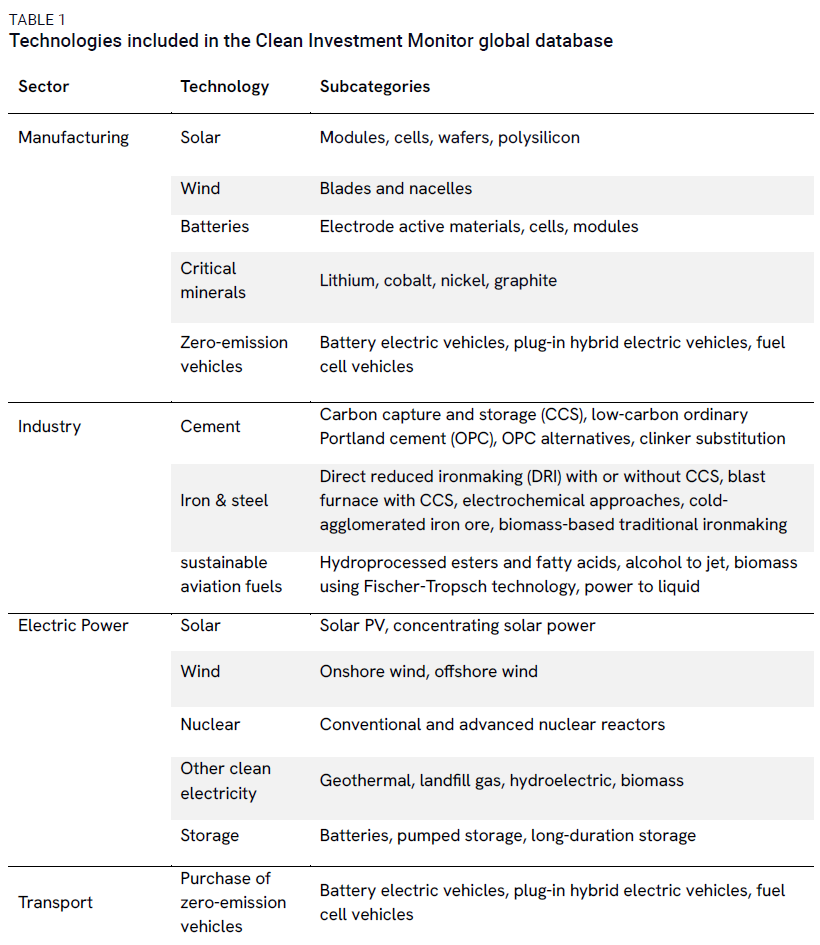
This taxonomy differs from CIM’s US database, where investments are grouped by segments reflecting investment in manufacturing (“Manufacturing”) and investment in the deployment of that technology, both to produce clean energy or decarbonize industrial production (“Energy and Industry”), and through the purchase and installation of that technology by individual households and businesses (“Retail”). In practice, this means that whereas distributed solar and retail purchase of vehicles are grouped in the Retail segment of the US CIM database, they are categorized as Electric Power and Transport, respectively, in the global database. The underlying investment accounting methodology remains consistent across both analyses.